


More More More at Wicken
Updated: Oct 29, 2025
More, more, more
How do you like it? How do you like it? (from the song written by Greg Diamond)
Well, if you're interested in Moths, you will absolutely love it at Wicken Fen. It really is the place to come. Join me on our three trips to Wicken Fen in 2025 as we make yet more exciting discoveries.

Photo by Stephen Thompson
May 24th - Eyes of the Fen
Moth-ers present on the night were: Stephen Thompson, Lois Clarke, Susie Fowler, Steve Lee, Martin Gray, and Toby Jewkes.
On our first trip of the year to Wicken Fen, Florence and Colin joined us, eager to experience their first Wicken Moth night. However, as the photo above shows, they spent most of their time relaxing or asleep in the wooden boats by the visitor centre. This left the hard work to everyone else. The forecast at one point looked very wet, and I thought I might have to cancel, but I took a chance. The worst of the weather went around Wicken, and we endured just a little light rain.
Six intrepid moth-ers met up at 8 pm, ready to seek suitable locations away from the wind and rain to set up ten traps/light sources around Sedge Fen. Although the year started slowly, Wicken is full of magic. Who knows what secrets await?

Photo by Stephen Thompson
.
The photo above shows one of my traps set up by the visitor centre, using a 125W Mercury Vapour bulb. The idea was that any moths attracted would also settle on the building and in and around the trap.
Photos below of some of the moths we recorded during the night:
Photos above by Lois Clarke

Where moth-ers fear to tread:
A ghostly apparition emerging from another world below the boardwalk. A Ghost Moth hiding from the busy feet of people.
Photo by Stephen Thompson


Photos by Lois Clarke
Two specialities of the Fen, Reed Leopard and Silver Barred, made an appearance.
These species are always sought after in this type of habitat at Wicken.
Photos by Stephen Thompson
The Eyes have it
I was checking one of my traps at about 00.30 when a huge moth flew in. I thought it was probably a Hawk Moth species, then it settled. It was a gorgeous Eyed Hawk Moth. Just look at the eyes on the hind wings—a fantastic way of warning off predators.
For more information on the Eyed Hawk Moth, check this link: https://www.ukmoths.org.uk/species/smerinthus-ocellata/

Photo by Stephen Thompson
A few of us stayed overnight, leaving some of the traps running all night, hoping that any rain wouldn't dampen our spirits. Luckily, the rain stayed away, the traps were closed, and we prepared for the public Meet the Moths event, which opened at 9.30 am. This always goes down well with the staff at Wicken and is well attended by the public, who are always fascinated by the wonderful world of moths.

An armful of Hawk Moths (Photo by Lois Clarke)
We recorded several species of hawk moths overnight. The photo above has two Eyed Hawks, a Pine Hawk and a Poplar Hawk. They were quite settled on my arm as I walked through the visitor centre, showing staff and visitors.
A video of me showing the Hawk Moths to the public
An Eyed Hawk and a Poplar Hawk after release. (Photo by Stephen Thompson)
We recorded a total of 102 species on the night, nothing new for the site on this occasion, but a good selection and a good number of Hawk Moths. Below is a link to download the species list for the night.
June 28th - One L of a night
Moth-ers present on the night were: Stephen Thompson, Steve Whitehouse, Lawrence & Ian Machin, Seb Buckton, Jonathon Newman, Malcolm Hillier, Lois Clarke, Susie Fowler, Robert Smith, and Les Gardner.

Photo by Stephen Thompson
Mothing can become quite addictive and often involves a significant amount of equipment. As you can see, my collection of gear has expanded considerably and now includes Florence, my mobile moth wagon. It provides space for my equipment, a comfortable place to sleep, and, of course, somewhere to make coffee and a bacon roll.
Overnight parking is generally prohibited at Wicken Fen; however, we have obtained special permission due to overnight survey activities.
The weather was looking good, with a hot day and a very warm night ahead, and temperatures around 18 °C expected. I arrived early to set up Florence and get all my kit ready. Once everyone had arrived, we had a chat about who was going where and what traps they had. It was a frantic next hour or so as everyone was back and forth, setting traps and laying cable. We were all hopeful of an excellent night with the weather conditions. Would we get the magic 300 species? Would we get any new moths? Read on to find out how we got on.
Photos by Stephen Thompson
Our group of 11 people was surveying the fen, equipped with 27 traps and a range of light sources, including Mercury Vapour Bulbs, Actinic Bulbs, and LED lights. The map below indicates the approximate locations of all the traps. As we moved around during the night, some participants carried nets and frequently caught moths using torchlight.

Some of the moths seen during the night:
Photos by Stephen Thompson
There are about 34 species of Plume Moth in the UK. Plume moths are delicate-looking Insects that do not look like conventional moths. We recorded several species on the night. Below are some of them, including Rose Plume, which was only new to Wicken Fen in 2024.
Triangle Plume photo by Lois Clarke, the other images are by Stephen Thompson.
Mothing excitement continued through the night with some exciting discoveries:

It really was turning out to be one L of a night. I was checking one of my traps over near the restaurant when I noticed a moth on the outside wall. It was an L-Album Wainscot, one I had never seen before. A moth with distinctive L-shaped markings on the wings, it likes damp habitats.
It was later discovered to be a new species for Wicken Fen.
Photo by Stephen Thompson

Lapping up all the excitement of the night was this incredible moth, looking just like a leaf and rescued from near someone's foot before it was trodden on. A Lappet Moth
Several more of these leaf-like moths were found in the traps.
Photo by Stephen Thompson

The Marsh Carpet is a nationally scarce moth found in fenland and marsh-type habitats in some parts of Cambridgeshire and a few other locations. It truly is a special moth that people want to see when they come to Wicken Fen. Susie Fowler spotted it in one of her LED traps in the meadow to the right of the visitor centre.
Photo by Susie Fowler
Several of the group stayed overnight to keep some traps running. We were up early to switch them off and cover them up before we started going through and examining what we had caught. Some of the traps (including my three) were left for the public demo later in the morning. The public demo was scheduled from around 9:30 am to 10:30/11, where visitors could come along and find out more about moths, see them up close, and ask any questions. It is always a really popular event with people of all ages taking an interest. It took ages to go through my 3 traps as we were finding so many more than we had seen through the night. I think I added another 30/40 species to the list. By midday, we were finally finished, and Florence was packed and ready to go.
Some of the highlights from the morning are below:

This Clancy's Rustic was recorded from Steve Whitehouse's trap and was the 3rd record of this species at Wicken Fen. It was also a new species for me and one I had been hoping to see for a while.
Photo by Stephen Thompson
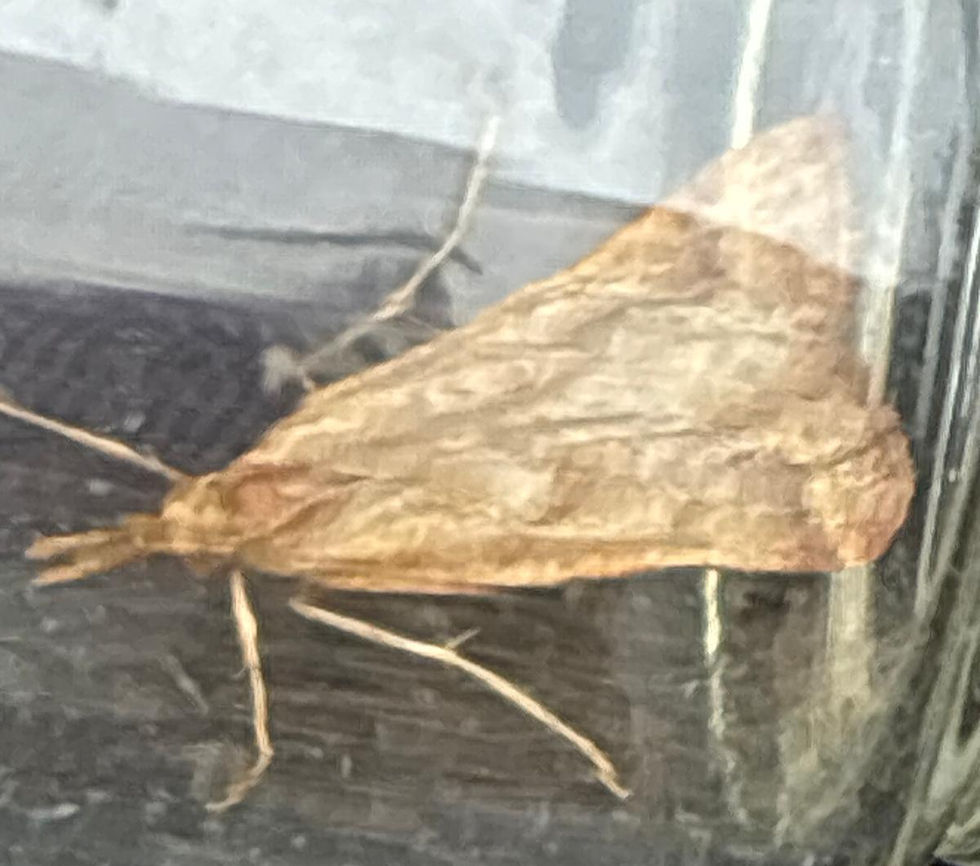
This moth was nearly missed and found by Les before the egg tray was cleared.
Only the second record for Wicken Fen was Synaphe punctalis. It was also a new
Photo by Les Gardiner

This is a scarce Moth, but we usually find it at Wicken in August. A close relative of the Chocolate Tip Moth, it is found in damp woodland and boggy habitats.
Photo by Stephen Thompson
Muslin photo by Lois Clarke, the other 3 by Stephen Thompson
This was probably the best night we have ever experienced at Wicken Fen, with near-perfect conditions and a lot of moth traps out, we amassed a massive total of nearly 400 species. (Pending confirmation by CMR, some moths will need to be examined under a microscope, and if a species cannot be proven, it will not count.)
Wicken continues to amaze us all. It truly is a remarkable place.
Below is part of an Email I received from Stuart Warrington at Wicken, with details on the status of some of the moths we recorded, followed by a link to download the complete list of species recorded on the night.
NEW to Wicken Fen's moth list are these TEN species:
Mythimna l-album L-album Wainscot [an immigrant, but possibly breeding in the UK now?]
Bohemannia quadrimaculella Four-spot Dot.
Caloptilia honoratella Pale Maple Stilt (to be confirmed)
Carpatolechia fugitivella Elm Grey
Coleophora spinella Apple and Plum Case-bearer
Coleophora milvipennis Birch Case-bearer
Hellinsia lienigianus Mugwort Plume
Phyllonorycter sagitella Scarce Aspen Midget (to be confirmed)
Plodia interpunctella Indian Meal Moth
Scrobipalpa obsoletella Grey Orache Miner (to be confirmed)
Eucosmomorpha albersana
Others of Note are:
Cnaemidophorus rhododactyla Rose Plume [was new to WF in 2024]
Crassa tinctella Tinted Tubic [2nd WF Record]
Dichrorampha alpinana Orange-spot Daisy Moth [2nd WF Record]
Eucosma metzneriana Mugwort Bell [2nd WF Record]
Evergestis limbata Dark Bordered Pearl [3rd record]
Neosphaleroptera nubilana Deep Brown Shade (1st record for 100 years - to be confirmed)
Synaphe punctalis Long-legged Tabby [2nd WF Record]
Clancy's Rustic 3rd record
Endothenia pullana 4th record
Dusky Plume (12th record)
Aug 9th - Waved Wonderings
Moth-ers present on the night: Stephen Thompson, Steve Lee, Martin Gray, John Lamin, Lawrence Machin, Lois Clarke, Sue Fowler, Stephen Plummer, Seb Buckton, Robert Smith, Les Gardiner.

Photo by Stephen Thompson
Our August visit to Wicken is usually jam-packed with moths; last year, we recorded 273 species, so we were hoping for much of the same, but the weather was the opposite of what we wanted for a good night. There was a bright moon, clear skies and the temps had cooled, so getting anywhere near last year's total was going to be difficult. We had a total of 22 traps out. Wicken is always full of surprises —will we get one this time? Read on to find out more:
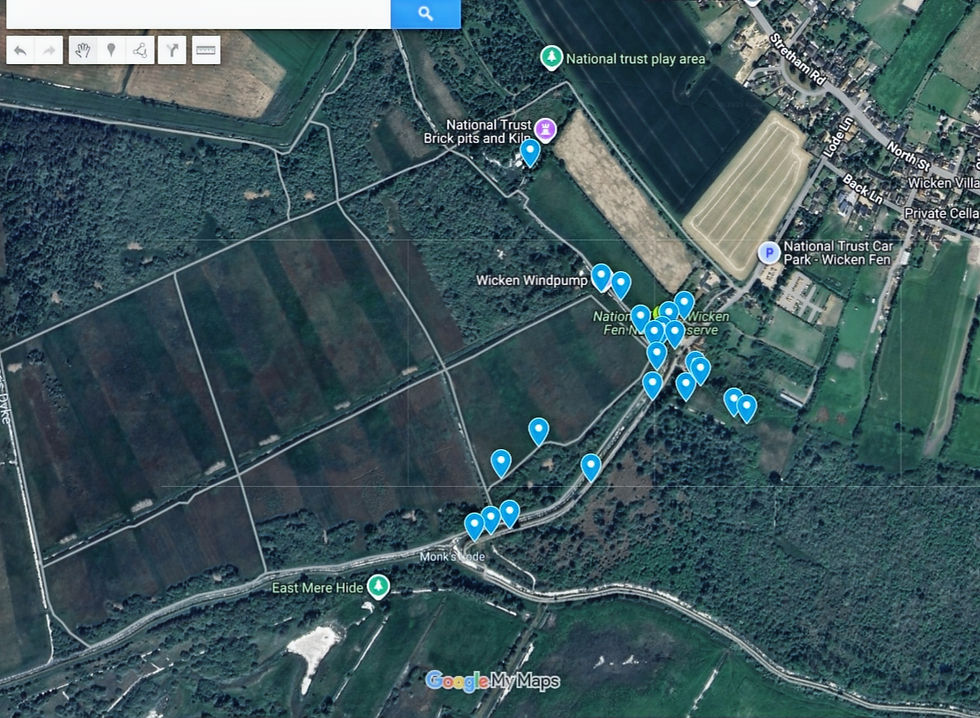
Below is a map of roughly where the traps were sited, a bit more spread out this time, with traps further along the path towards Adventurer's Fen.

Wig-wam bam, gonna make you my moth
Wam bam bam, gonna get you if I can.
(Based on lyrics by Nicky Chinn and Mike Chapman)
Moth traps come in a variety of sizes and configurations. But not always a box and a bulb. The photo on the left shows a WigWam setup with a bulb in the middle of the tent-like structure, all on a white sheet.
Photo by Stephen Thompson
Some highlights from the night:

A Marbled Clover was attracted to the light run by Stephen Plummer. The moth is a resident of the Brecks of East Anglia.
Photo by Stephen Thompson
Photos by Stephen Thompson
A shadowy creature emerged from the darkness.

Photo by Stephen Thompson
While wandering around, checking my traps, I noticed a dark-coloured moth on the side of one of them. I bent down to take a closer look and discovered it was a Waved Black. Fantastic, I thought. I have been wanting to see one of these for ages. Later on, I found it was also another new species for Wicken Fen. What a year It has been on the fen in 2025.
The morning's public demonstration once again proved to be a popular attraction for visitors. Below are some of the highlights from the opening of the traps:

A Lunar Yellow Underwing caught by Lawrence Machin
Photo by Stephen Thompson

The Lime Hawk Moth is an unmistakable, large, green moth that usually flies from May to July. In some southern counties, there can be a partial 2nd brood, meaning Adults can be seen in August and September. I have never seen one before this late in the year.
Photo by Stephen Thompson

The Red Underwing is a moth I haven't seen for quite some time. This is one of several we caught during the night.
Photo by Stephen Thompson

Reed Leopard, one of the many specialities of Fens and Marshes
It can only be found at Wicken Fen, Chippenham Fen in Cambridgeshire, the Norfolk Broads and a location in Dorset.
Photo by Les Gardiner
Photos by Lois Clarke
Below are some quotes from people at Wicken Fen and two of my team, Seb Buckton and Steve Lee:
I would like to thank Stephen for the opportunity to attend these mothing sessions at Wicken Fen.
I like to 'moth' at locations other than home or relatives', as a way to increase the number and diversity of species I have personally seen.
Often, these 'remote' sessions are done alone, which is fine by me, and I am happy being a lone 'mother' - usually 🙂
However, I also appreciate the opportunity to Moth in the company of others, like-minded (and extremely knowledgeable) folk, and find the sessions good, sociable occasions.
And to be able to do so in such a species-rich habitat as Wicken, with its diverse fauna (not forgetting the flora), adds to the enjoyment.
One never knows what one is likely to find next! Yes, of course, predictions can be made - but the findings tend to have a habit of exceeding those predictions 🙂
And there is satisfaction to be gained by being able to assist in something much bigger than I could achieve as an individual.
Plus, one never knows what else one might see and experience - Water Voles, Barn Owls, Great Silver Diving Beetles, Muntjac - there is a whole cornucopia of potential delights out there, waiting to be found!
I look forward to future sessions.
Steve Lee, Moth-er, Bedfordshire
When opportunities arise for mothing at Wicken Fen, I’m always keen to make the journey, despite living about 150 miles away in Gloucestershire. Wicken has a special place in my heart – I visited several times, 5-10 years ago, with my (then) young children and their grandparents, who live near Cambridge. Their grandma (my mum) was particularly fond of the place, even naming her lurcher Wicken. Both are no longer with us, so when I first heard about the possibility of joining a team of moth trappers there in 2023, I jumped at the opportunity. Each year since I joined, I have attended two group trapping events, and although numbers of moths vary due to the weather, there’s always something interesting and often species I’ve not seen before. In 2025, conditions were excellent and the number and variety of moths were outstanding, with several interesting and unusual species recorded. As well as the moths, it’s always great to meet up with both local Cambridgeshire moth trappers, but also others who have travelled from further afield. Combined with adding important data to our knowledge of this essential site for wildlife, makes mothing at Wicken one of the highlights of my mothing year.
Seb Buckton, Moth-er, Gloucestershire
Seb Buckton, Stroud, Gloucestershire.
"Wicken Fen is almost certainly the most important National Trust site for moths, both for its diversity and for its rarities. It also has one of the longest historic lists, with documented visits by entomologists going back to the 19th century. Thus, the surveys by Stephen Thompson and friends are hugely important to continue these investigations into this amazing biodiversity. The public demonstrations of moths caught and released provide the icing on the cake, so the public, especially youngsters, can see and appreciate these wonderful insects".
Stuart Warrington (NT volunteer and Wicken advisory group member).
"At Wicken Fen, we're proud of the reserve's rich and diverse habitats, which provide essential food sources and breeding grounds for a spectacular variety of moths. This includes many rare and some nationally significant species. A scarce moth, the six-belted clearwing, was recently recorded as the 10,000th total species (and 1,280th moth species) at the site, underscoring its crucial role in moth conservation across the UK.
A huge thank you must go to Stephen, whose continued commitment to surveying and showcasing these fascinating insects is invaluable to our understanding and appreciation of Wicken Fen's biodiversity. We're grateful to have him and his team present to educate and inform curious visitors, spreading the word about the incredible variety of moths.
Jack Stevens, (Acting Programming and Partnerships Officer, National Trust) "
Below is a link to download the list of species seen in August:
Since 2021, I have been documenting moths at Wicken Fen. It has been a true privilege to contribute to the monitoring of these incredible insects and to the impressive list of species at Wicken, which has now surpassed 10,000. Wicken Fen is undoubtedly one of the most remarkable nature spots in the UK and continues to exceed expectations. I strongly encourage a visit. Come and see what you can find.
Check this link for more information: https://www.nationaltrust.org.uk/visit/cambridgeshire/wicken-fen-national-nature-reserve


Comments